Craving something sour, salty and hearty? This solyanka soup recipe gives you a Russian meat soup of beef, sausage and pickles, finished with sour cream and a slice of lemon.
Looking for more dishes like this one? Browse all our russian recipes.
| Item | Value |
|---|---|
| Basic types of solyanka | Three: meat, fish and mushroom |
| Most popular type | Meat solyanka |
| First written mention | 17th century |
| Earliest recipe cited in Russian culinary literature | 1794 |
| Soup version emerges | 1830s |
These figures come from Wikipedia and The Moscow Times. Food history gets revised, so check the sources before you rely on them.
What solyanka is and why it tastes the way it does
Solyanka is a thick, sour soup that Folkways Today calls traditionally Russian, now enjoyed across the former Soviet space and Eastern Bloc, and particularly in East Germany. Think of it as a bowl of savory, salty, tangy comfort.
The sourness comes mostly from brine, and in older recipes sometimes from vinegar, according to The Moscow Times. Because the main ingredients are preserved vegetables, the soup ends up quite salty as well.
Most versions are loaded with meat. Cooks often treat the pot as a clear-out-the-fridge dish, and leftover chicken, beef, pork and any type of sausage all have a place in it.
Ingredients for a meat solyanka
This version follows the meat solyanka recipe published by Folkways Today. Treat the quantities as a starting point and adjust to your taste and your pot.
- 350 g of beef
- 2 white onions
- 250 g of smoked sausage
- 250 g of ham sausage
- 4 pickled cucumbers
- 2 tablespoons of vegetable oil
- 2 tablespoons of tomato paste
- 100 g of olives
- 2 Vienna sausages
- 100-120 ml of pickle brine
- Salt to taste, plus herbs, sour cream and lemon for serving
The pickle brine is what gives the broth its tang, so use the liquid from a jar of good salted cucumbers rather than a sweet pickle.
How to make solyanka step by step
The same source says you should be able to make solyanka within an hour, with the longest step being to cook the meat. The tomato base needs about 15 minutes of simmering while the beef finishes.
- Put the beef in a pan of cold water and bring it to the boil, skimming off the foam. Cover the pan and let the meat cook until tender.
- Cut the onions into large pieces, and slice the sausages and pickled cucumbers into small strips.
- Heat the oil in a frying pan and fry the onions until golden brown.
- Add the smoked and ham sausage, and cook for a couple of minutes, stirring. Add the cucumbers and keep stirring.
- Stir in the tomato paste with a little water, cover, and let it simmer for about 15 minutes.
- Slice the cooked beef into strips like the rest. Put the beef, the fried vegetables, the olives and the sliced Vienna sausages into the hot broth.
- Pour in the pickle brine, stir, and season with salt. Bring the soup to the boil.
Taste before you add more salt, since the brine, olives and sausages already carry plenty. If the soup is too sharp, add a splash more broth; if it is flat, add a little more brine.
How to serve solyanka
Before serving, sprinkle the soup with herbs and add sour cream and a slice of lemon. Folkways Today says it is typically eaten with sour cream and dill stirred into it and with dark bread on the side.
For a fuller table, Russian Life notes that solyanka is usually served with pirozhki. Our pirozhki recipe is a good place to start if you want something to go alongside.
The soup works as a starter or a main dish, and it suits cold-weather lunches and dinners best, since it is always served hot.
Where does solyanka come from?
The first written mention dates to the 17th century, but it was not yet a soup. The Moscow Times describes it as a hot dish of cabbage, salted cucumbers, meat, poultry, fish, mushrooms or other products.
One of the first recipes in Russian culinary literature comes from Nikolai Osipov’s book from 1794, according to Wikipedia. Even in 1822, the Dictionary of the Russian Academy still described solyanka as a main course rather than a soup.
The soup form arrived in the 1830s. The chef Gerasim Stepanov placed it in 1834 under “Miscellaneous Shti”, next to nettle soups and Ukrainian borscht, so our shchi recipe makes a natural comparison. Both dates are covered by Wikipedia and The Moscow Times.
The writer Konstantin Skalkovsky joked that Moscow solyanka was a parody of Polish bigus, and The Moscow Times says the joke is not too far from the truth.
What the name tells you
The original name selyanka can be translated as “settler’s soup”, and it later turned into solyanka, a nod to sol, the Russian word for salt, Wikipedia explains. Russian Life adds that in old Russia solyanka meant mishmash or muddle, which suits a pot of mixed meats.
The same magazine says nobles later made it a delicacy by adding kvas, lemon, olives and capers. That is why lemon and olives belong in a modern bowl.
Fish, mushroom and other variations
Folkways Today stresses that, with countless variations across Eurasia, there is no one correct way to prepare solyanka. Wikipedia sorts the soup into three basic families.
- Meat: the most popular type, as Wikipedia puts it, and the one cooked above.
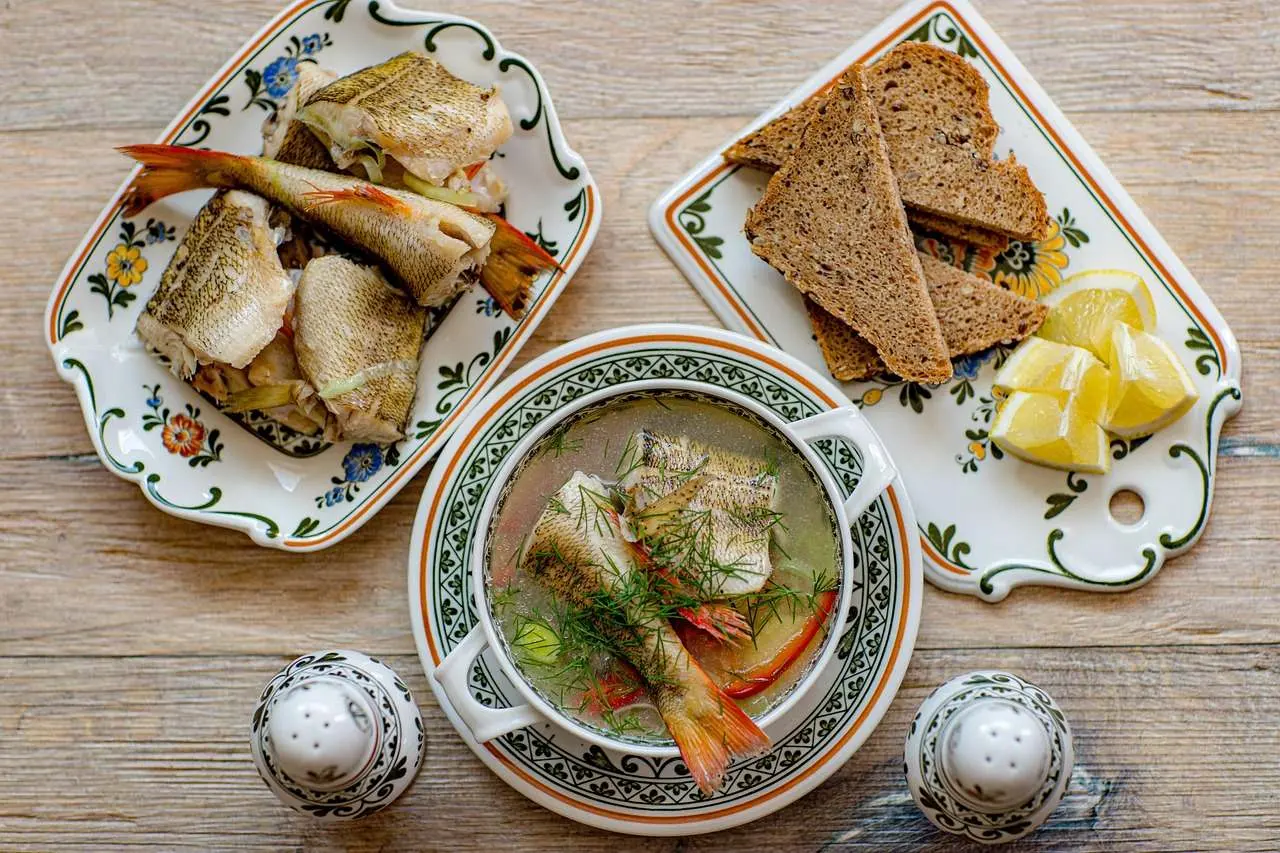
- Fish: prepared in a similar way, but with salt-cured and smoked fish such as salmon or trout in place of meat.
- Mushroom: built on mushrooms and onions, and easy to make vegan according to Folkways Today.
Fish and mushroom soups are especially popular on fasting days of the Orthodox calendar, when observant Russians eat as pescatarians or vegetarians. Swap the beef and sausages for one of these and keep the brine, olives and lemon.
Frequently asked questions
Is solyanka the same thing as selyanka?
Show answer
The two spellings are tangled together. Some people say selyanka is fried cabbage with meat while solyanka is the soup, yet early recipes drew no clear line between them in practice.
Can I make solyanka without meat?
Show answer
Yes. A mushroom version keeps the pickles, olives and brine, and it can be made fully vegan. Check the stock and sour cream if you want to keep the whole bowl meat-free.
Does solyanka really cure a hangover?
Show answer
It has that reputation. Wikipedia says its astringent sour taste is believed to relieve a hangover, but treat that as folklore, not medical advice.
Why is solyanka so salty?
Show answer
Brined cucumbers, olives and cured sausages are all salty on their own. Add the pickle brine at the end and season only after tasting.