Wondering how a russian tea samovar works? A central pipe holds the fuel that heats the water, a small pot on top brews strong zavarka, and you dilute each cup to taste.
This guide sits inside the wider world of russian drinks, and it covers the device, its history and the habits around it.
| Item | Value |
|---|---|
| Meaning of “samovar” | Literally “self-boiler” |
| When the samovar was invented | 18th century |
| Minimum brewing time for zavarka | Five minutes |
| Year a Mongolian ruler gave tea to Tsar Michael | 1638 |
| Wide use of the samovar for boiling water | Until the middle of the 20th century |
These figures come from the University of Kansas CREES samovar page and Wikipedia’s article on Russian tea culture. Dates and details can change as scholars revise them, so check the sources before you rely on them.
How a samovar works
The word samovar literally means self-boiler, and the name fits a vessel built to keep a large supply of hot water ready, as the University of Kansas CREES page explains.
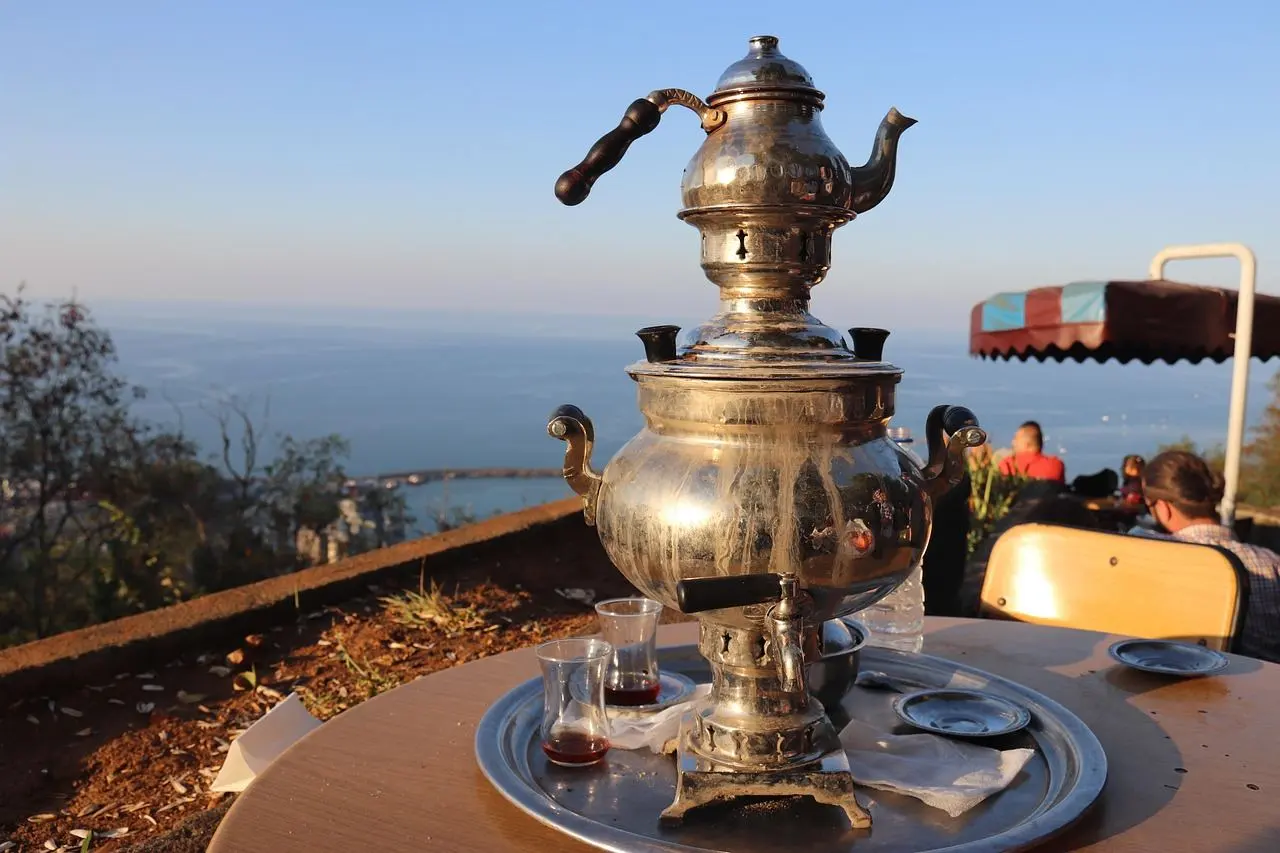
The Spurlock Museum describes antique models heated with coal or charcoal. They have a body that holds the water, a faucet near the bottom, and a vertical metal pipe where the fuel burns. A teapot sits on top of the body once the water boils.
A tea session with a traditional model runs like this:
- Fill the body with water and light the fuel in the central pipe.
- When the water boils, set the small teapot on top, filled with loose tea.
- Let the leaves steep into a strong concentrate called zavarka.
- Pour a little zavarka into each glass or cup, then top it up with hot water from the faucet.
Because the water stays hot, a hostess could serve unexpected guests at any hour, according to the Spurlock Museum. That is a large part of why the samovar became a symbol of hospitality.
Older fuel-burning designs are not the only kind. The KU CREES page notes that the original samovars burned coal or wood chips, while you can now find electric samovars too.
Where the samovar came from
The samovar was invented in the 18th century as a hybrid of two older devices. One was the Russian sbitennik, used to heat sbiten, a drink of light beer, honey and spices; the other was the Dutch bouilliotte, used to heat mulled wine, according to the University of Kansas CREES page.
The sbitennik had a spout like a kettle, which meant lifting the whole container to pour. The samovar combined elements of both devices into a vessel that burned wood or coal and had a spigot, as the same page describes.
Tea itself arrived first. Wikipedia says tea culture accelerated in 1638, when a Mongolian ruler donated four poods of tea to Tsar Michael. The same article adds that the difficult trade route kept prices extremely high, so tea was available only to royalty and the very wealthy at first.
Tea then spread down the social ladder. Global Voices reports that the first people to drink it regularly were the inhabitants of Siberia in the 18th century, both Russian peasants and Indigenous peoples.
Tula became the centre of samovar making. The KU CREES page calls it the samovar capital of Russia, and one brass example at the Spurlock Museum was made in the town of Tula, 100 miles south of Moscow. The KU page also notes a Russian proverb that tells you not to take your own samovar to Tula, a bit like bringing corn to Nebraska.
The samovar stayed in everyday use for a long time. Wikipedia says it was widely used to boil water for brewing until the middle of the 20th century.
How Russians brew and serve tea
Russian brewing is a two-step process, as Wikipedia puts it. First you make a strong concentrate, then you thin it with hot water.
The KU CREES page says zavarka is brewed from loose leaf tea for a minimum of five minutes. Each person then dilutes it with hot water to their own preference, which lets a single pot satisfy strong and mild tastes alike.
The glass matters too. According to Global Voices, tavern tea was once served in glasses without handles that burned the hands, which led to the podstakannik, a metal glass holder. The same essay says podstakanniks began to be used on trains in 1892.
Sweetening is a personal matter. The KU page lists the usual choices:
- sugar
- honey
- jam
Drinking it with none of these is called “naked tea”, the KU CREES page says.
Which tea goes in the pot?
Traditionally, black tea is the most common tea in Russia, and green tea is becoming popular too, according to Wikipedia. A style called Russian Caravan has a smoky flavor said to come from the campfires of caravans that spent sixteen to eighteen months on the road from China.
The same article says that people, especially in the countryside, add herbs and berries such as mint, blackcurrant leaves or raspberries. Sometimes fireweed replaces tea leaves altogether.
Tea-table manners and what goes with the tea
Tea is a meal’s companion rather than a ceremony. Global Voices contrasts it with East Asian practice: Russian tea drinking has almost no ceremonies and is marked by long, heartfelt conversations.
Food is part of the deal. The KU CREES page says it would be rude to serve tea without something to eat. The Global Voices essay lists honey, jam, fruits, cream, buns, pies and cookies as typical treats.
Timing is worth knowing. Colorado College’s Russian tea ceremony page says tea is consumed after meals and during mid-afternoon breaks, and is not considered appropriate with a meal. It also describes the old custom of clearing the supper table, setting the samovar in the center and gathering the whole family around it.
If you are invited to a Russian home, expect loose tea. ITMO University reports that tea bags are frowned upon when you are entertaining guests.
Global Voices also says the familiar taste from Soviet stores was a blend of teas from various regions, which might explain why lemon has become a quintessential addition to Russian tea. If you would like a cold drink after all this hot tea, try this kvass recipe, and if the evening moves on to stronger drinks, read how to drink vodka russian style first.
Is the samovar still used today?
Rarely in daily life. In an article dated October 2024, ITMO University says samovars are no longer a common household item but something found in a museum.
Global Voices agreed in May 2024, writing that the samovar can now mostly be found in museums or traditional restaurants. The same essay says tea cozies, which cover the teapot, can still be found in some families.
The habits survived the hardware. ITMO describes steeping loose tea in a small teapot, pouring the strong zavarka into each cup and topping it up with hot water, a direct echo of the samovar routine.
Frequently asked questions
What is zavarka?
Show answer
It is the strong tea base you make first, usually in a small pot. Each drinker then adds hot water until the cup suits them, as the Spurlock Museum also describes.
Do you need coal to use a samovar?
Show answer
No. Electric versions exist, and the Colorado College page shows a fairly modern electric model while noting that older ones burned coals or wood in a pipe through the center.
Can you serve tea on its own?
Show answer
Hosts traditionally avoid it. ITMO University says it was considered unseemly to serve tea without snacks, so put out pastries, sweets or sandwiches, as the ITMO article suggests.
Is Russian tea always black tea?
Show answer
Black is the traditional default, but not the rule. According to Wikipedia, green tea is gaining ground, herbal additions are common, and fireweed can stand in for tea leaves.